



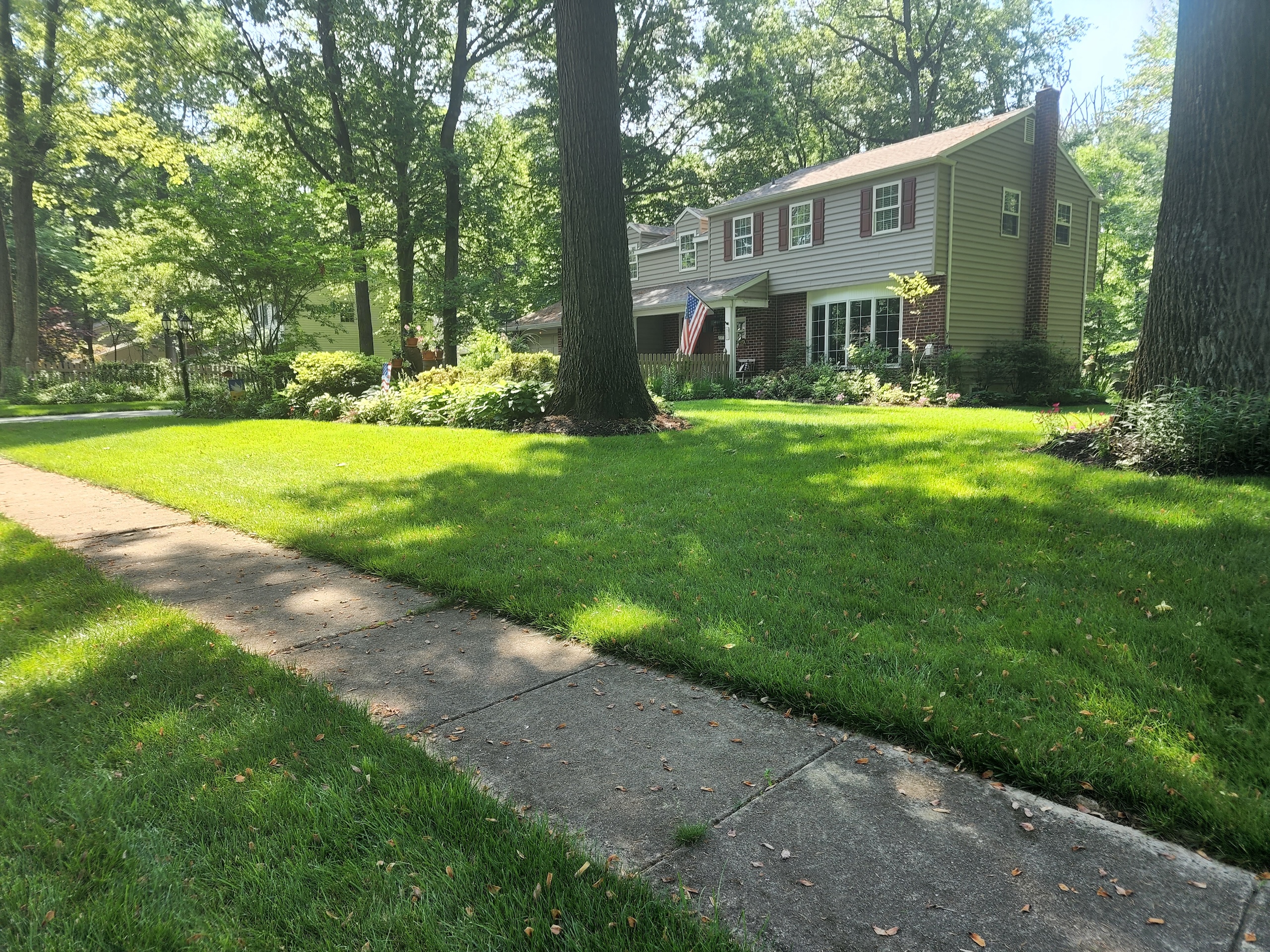
Every summer, we hear the same handful of beliefs about lawn care across Chester County, Delaware County, and the rest of the region. Most of them sound reasonable. A few of them are actively working against the lawn they are trying to help.
None of this is about blaming homeowners. Cool-season grass in a warm, humid climate behaves in ways that are not always intuitive, and a lot of common wisdom simply does not hold up here. So let us walk through the myths we run into most, and what is actually going on underneath them.
Quick list, if you are skimming
- Myth: Brown grass just needs more water.
- Myth: A rainy summer means a green lawn.
- Myth: Cutting short means less work and no downside.
- Myth: A great spring lawn will stay great all summer.
- Myth: If disease shows up, the lawn will grow out of it.
Each one below has a kernel of logic, and a catch.
Myth 1: "If my lawn is turning brown, it needs more water"
This is the most common one, and the most costly, because the fix people reach for can make the problem worse.
Brown can absolutely mean drought stress. But in summer it often means disease, and the two call for opposite responses. Piling on water, especially in the evening, keeps the lawn wet longer and gives fungal pathogens exactly what they need to spread.
The key distinction: a lawn can recover from drought stress. It has a much harder time recovering from disease stress, particularly once you have been feeding that disease with extra water.
Before you turn up the irrigation, it is worth figuring out which problem you actually have. Which leads to a related myth.
Myth 2: "A rainy summer means a lush green lawn"
It seems obvious. More rain, greener grass. In our climate, it often works the other way.
The cool-season grasses we grow here (tall fescue, Kentucky bluegrass, perennial ryegrass) are not built for heat and humidity. When a rainy stretch combines with warm nights, all that moisture does not just feed the grass. It feeds disease.
What to look for: on wet mornings, check for fine, cottony, web-like strands across the turf. Most people assume it is spider webbing. It is often mycelium, the visible sign of active fungal disease. That "spider web" is a clue that a rainy summer is doing the opposite of what you would expect.
Myth 3: "Cutting it short means less mowing and a cleaner look, with no real downside"
The appeal is understandable. Cut lower, mow less often, get that crisp look. The downside just is not visible right away.
Mowing too low stresses cool-season grass and thins it out, which leaves more room for weeds and more openings for disease. Dull blades make it worse by tearing the grass rather than cutting it cleanly, and a torn blade is essentially an open wound that invites infection.
Here is the part that surprises people:
- Height matters more than frequency. Get the height right and how often you mow becomes far less important.
- Taller grass roots deeper, which helps it handle heat and summer stress better.
- A clean cut from a sharp blade keeps the plant far less vulnerable when conditions get tough.
Short can look sharp in a photo. The question is how it holds up through July and August.
Myth 4: "My lawn looked great in spring, so it will be fine all summer"
Spring is the easy season here. A cool-season lawn tends to look its best in spring and fall, when temperatures suit the grass.
Summer is the stress test. Once daytime temperatures climb past 85 and nights stay warm, the exact conditions that made spring easy flip against the lawn. A lawn that looked perfect in May can start thinning and patching within days once disease pressure sets in.
Why this happens: we are essentially asking a non-native, cool-climate grass to thrive in a warm, humid one. It performs beautifully when the weather cooperates, and it needs real support when the weather turns. A strong spring is not a guarantee of an easy summer.
Myth 5: "If disease shows up, the lawn will grow out of it on its own"
Sometimes minor issues do clear on their own. The dangerous summer diseases, like brown patch, generally do not.
Here is the reality of how it plays out:
- Summer disease subsides only when the weather pattern breaks, meaning temperatures drop below the threshold that fuels it. In our region that often does not happen until fall, since even September can stay hot.
- If the disease reaches the crown of the plant, the base, the plant may not recover at all.
- Left unchecked, a lawn can be damaged badly enough that it needs to be repaired with seed in the fall.
- The worst case is disease followed by drought. A lawn already stressed by disease that then dries out and stops growing has no real chance to recover on its own.
Waiting it out is a gamble, and the odds get worse the longer the summer pattern holds.
The thread running through all of them
Notice what these myths have in common. Each one assumes a lawn here behaves the way you would expect grass to behave. In Southeastern PA, with cool-season grass in a warm, humid climate, that assumption is exactly where things go wrong.
The good news is that once you understand the pattern, summer becomes far more manageable. Proper watering, correct mowing height, and preventative disease protection during the high-pressure months keep a lawn resilient through the season instead of leaving it to fend for itself.
That is the foundation of our Summer Solstice Lawn Disease Program, built specifically for the conditions we see across Southeastern PA. If your lawn has followed the green-spring, brown-summer pattern year after year, there is usually a reason, and usually a fix.
To talk through what is happening with your lawn, reach out to our team at 610-350-7854 or visit dtltotalturf.com. We are glad to take a look.